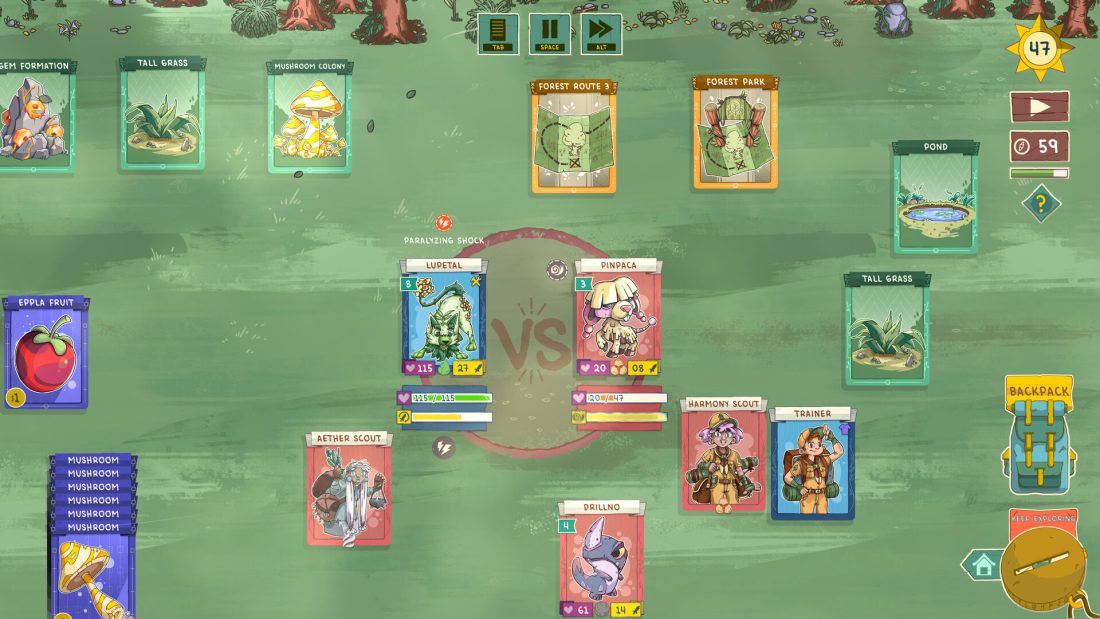
Sylvan is the Plant Leader, and his Plant Arena challenge uses Flowf. Treat the fight as a preparation check. Stackmon resolves combat automatically, so the useful decisions happen before you trigger the arena: which two roles you field, whether their equipment and abilities are live, and whether recovery is already staged on the board.
A recorded August 2026 win used a level 10 Lupetal with a level 5 Lusfin. That proves the challenge does not require a pair of identical high-level attackers; it does not establish universal minimum levels. Levels, card stats, and balance can change after launch. Use the current numbers on your cards and the first exchange of the fight as the readiness test.
Before selecting the challenge
- You are at the Plant Arena and Sylvan’s leader dialogue has made the challenge available.
- Your active pair has two different jobs rather than two fragile copies of the same plan.
- Equipment and learned abilities are assigned, not merely owned elsewhere on the board.
- Recovery cards such as Hepi Berry are reachable before the fight begins.
- You have room to read the reward sequence after victory instead of immediately dragging cards away.
Read the arena state before waking the fight
Do not tap through Sylvan’s dialogue and assume the leader card behaves like a normal resource stack. The reliable sequence is:
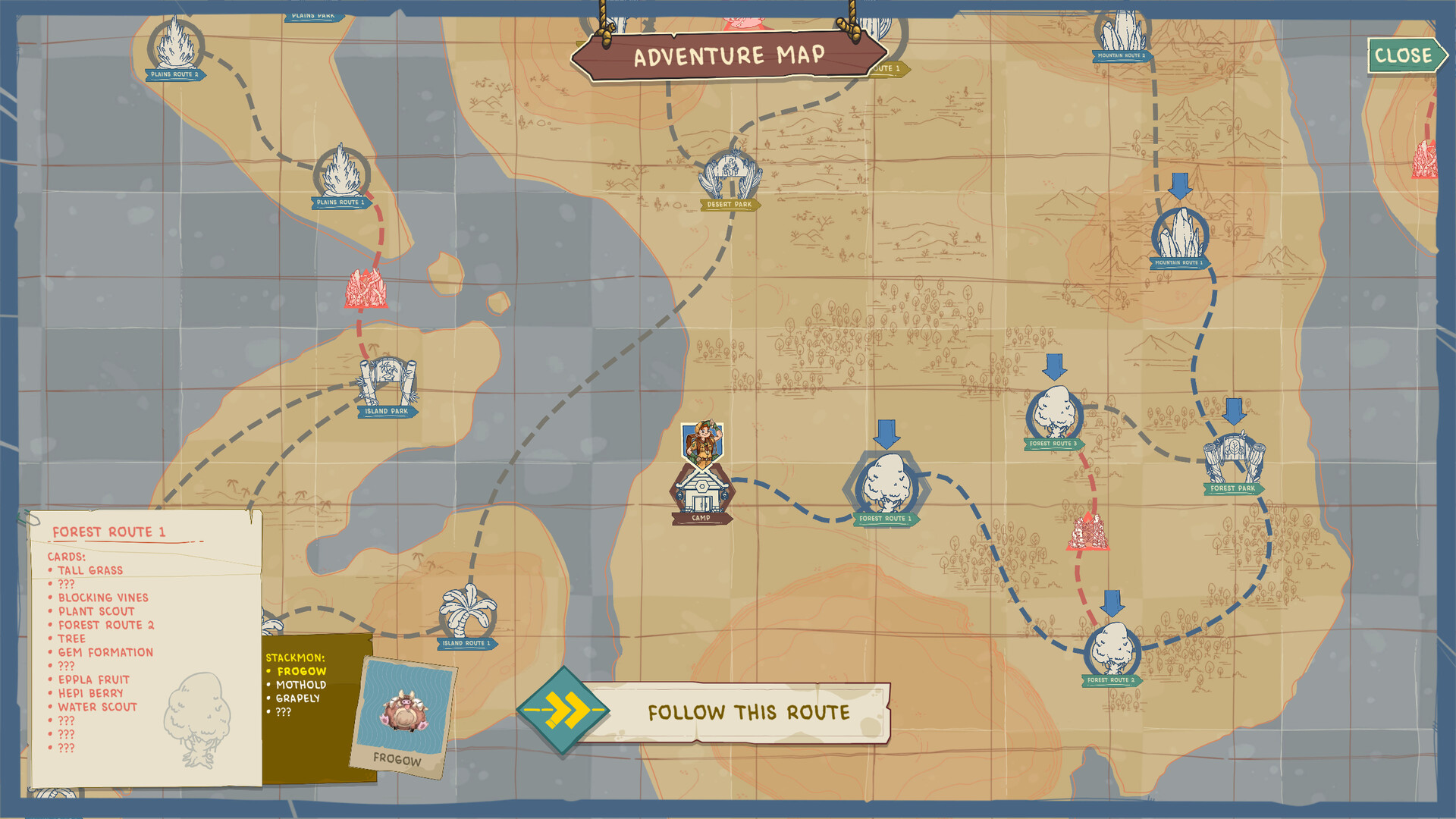
- Reach the Forest-side Plant Arena and identify Sylvan in the leader dialogue.
- Confirm that the board presents the Plant Leader challenge, not an unrelated trainer, rival, or ordinary encounter.
- Make enough open space around the active team to see equipment, abilities, food, and any card produced by the result sequence.
- Inspect Flowf when the challenge begins. Its current health, attack, ability text, and affinity indicators are better evidence than a launch-day number copied from another save.
- If the displayed opponent or rules differ from this page, stop and follow the current client. A post-launch patch outranks the recorded run.
This preflight prevents the most expensive mistake: spending time on a loss whose cause was visible before the first hit. An empty equipment slot, unavailable ability, damaged lead card, or inaccessible recovery stack will not fix itself after automatic combat starts.
Give the pair two jobs, not one shared weakness
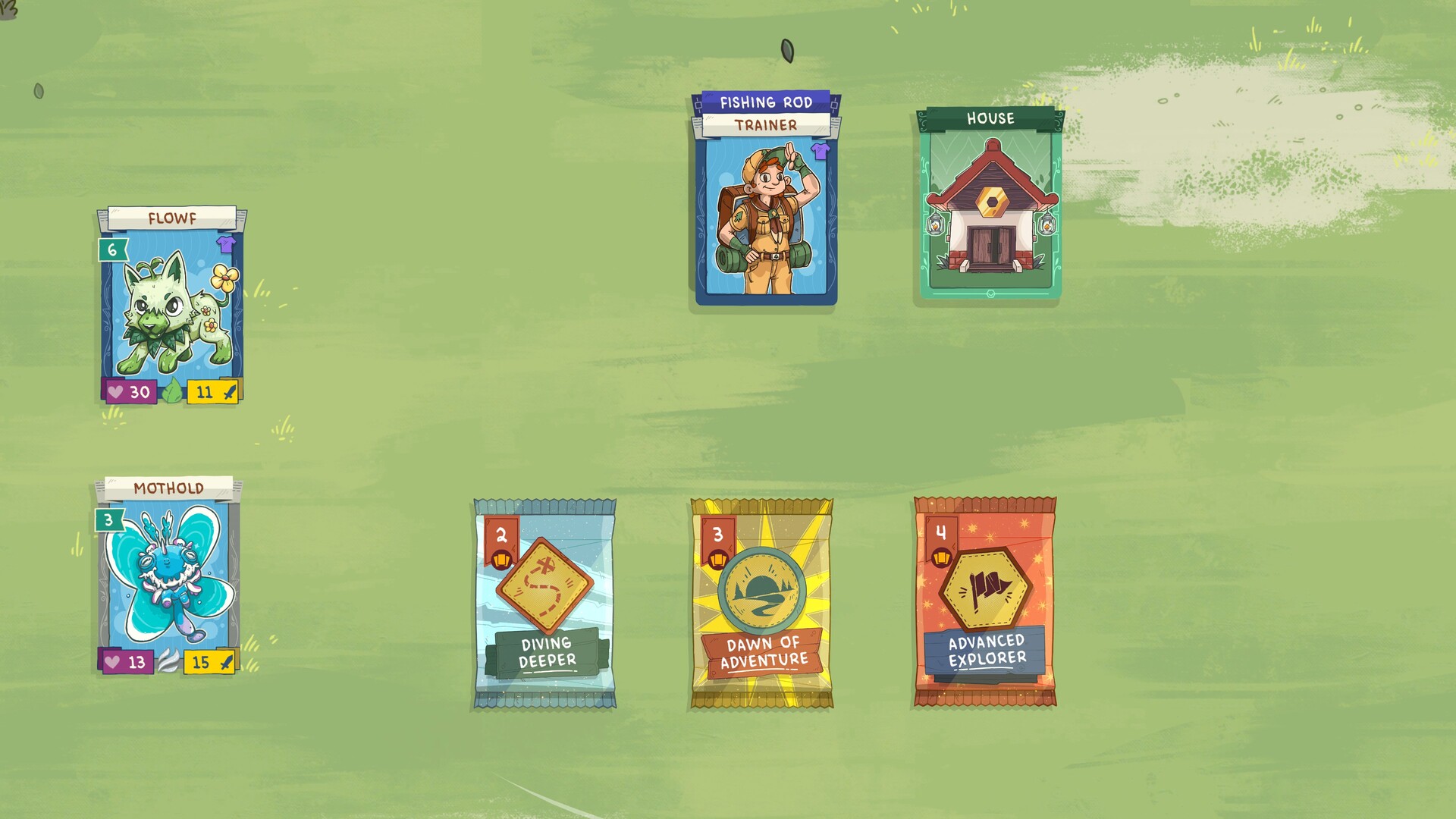
The winning Lupetal and Lusfin example is useful because their levels are unequal. It shows why a rigid “both cards must reach level X” rule is the wrong diagnostic. Ask what each slot contributes.
| Job | What you need to see | Failure signal | Adjustment |
|---|---|---|---|
| Lead survival | Enough health, mitigation, or recovery access to remain present through Flowf’s early pressure. | The lead disappears before the second card can convert its damage or ability. | Heal first, equip a defensive card, or move the sturdier Stackmon into the exposed role. |
| Reliable output | Damage or an ability cycle that reduces Flowf faster than the team loses effective health. | Both sides remain active, but Flowf’s health barely moves between exchanges. | Replace dead utility, improve the damage slot, or use a learned ability whose current text contributes to the matchup. |
| Affinity control | No warning, resistance pattern, or repeated weak exchange suggesting the active attack is being blunted. | Nominal attack looks adequate but the actual health loss is consistently poor. | Read the current affinity UI and swap to a card or ability the client shows as more suitable; this guide does not invent an unverified type chart. |
| Recovery access | Food or healing is available where the fight setup can use it. | A healthy reserve exists elsewhere, but the active team enters damaged or cannot reach it. | Move the needed recovery beside the preparation area before re-triggering the challenge. |
If one card is carrying survival and the other is carrying output, a level gap can be acceptable. If both cards are low-health damage pieces, equal levels will not repair the structural problem. Conversely, do not force Lupetal and Lusfin if your save has a different pair with clearer jobs. The recorded composition is a verified winning example, not a mandatory roster.
Use displayed stats as a readiness test, not a copied target
Immediately before combat, compare three things on the actual board:
- Effective health: current health after any previous fight, plus recovery you can apply before committing.
- Time to remove Flowf: the visible attack and ability cycle of both active cards, judged against Flowf’s current health and defenses.
- Ability availability: the useful skill is learned and attached to the combat plan, not waiting as a book or card outside the team.
The official store describes automatic battles driven by abilities, equipment, and elemental affinities. That means raw level is only a proxy. A higher-level card with the wrong loadout can produce less useful pressure than a lower-level partner whose current ability fills the missing job.
Take a screenshot of the opening board if you are unsure. After a loss, that single frame tells you whether health, attack, ability assignment, or affinity was the bottleneck. Without it, players often spend materials on the highest visible level and repeat the same underlying failure.
Stage recovery before automatic combat takes control
The audited winning segment shows Hepi Berry among the prepared cards. Use that as a reminder to solve recovery before starting the encounter, not as a fixed shopping list. The recording does not prove a mandatory quantity, and future patches may change values.
- Finish any healing that can be applied safely on the board.
- Separate recovery from unrelated resource stacks so a last-second drag cannot target the wrong card.
- Keep the arena and team readable; a dense production pile makes it harder to see which creature is damaged or whether an item was consumed.
- Do not spend the final recovery card merely to make both health bars look symmetrical. Preserve it if the current health already survives the expected opening exchange.
A failed run should answer a question. If Flowf wins with a small amount of health remaining, one output or recovery improvement may be enough. If your lead is removed while Flowf is still healthy, the team needs a role change, not a tiny level increase. If an ability never appears to matter, verify its assignment and trigger rather than assuming its description was active.
Watch one exchange at normal speed
Automatic does not mean unreadable. Let the first exchange play slowly enough to identify the damage pattern. Speed controls can shorten a known result, but fast-forwarding the first attempt hides the evidence you need for the next one.
| What the first exchange shows | Diagnosis | Next attempt |
|---|---|---|
| Flowf loses meaningful health while both allies remain stable. | The plan is functioning; avoid unnecessary changes. | Let the battle resolve and preserve resources for a later gate. |
| Your exposed card drops much faster than Flowf. | Survival is the immediate constraint. | Heal, change the lead role, or equip durability before adding more damage. |
| Both allies live, but Flowf’s health barely changes. | Output, affinity, or ability activation is the constraint. | Replace low-impact utility and read current affinity/skill text. |
| A card enters below expected health. | The preparation state, not the arena balance, caused the bad start. | Reset the board, recover, and recheck the exact active pair. |
| The challenge state or opponent differs. | The client or progression context does not match the audited sequence. | Stop using this route as literal instructions and follow the live objective text. |
Change the smallest thing that matches the loss
Stacking every available upgrade onto both creatures can win, but it destroys the information from the failed attempt and may waste resources needed after the medal. Make one targeted change:
- Lost by a narrow health margin: restore current health or add one dependable survival improvement.
- Lost with Flowf still healthy: improve sustained output, skill contribution, or the affinity matchup shown in the current UI.
- Second card contributed too late: reconsider which creature takes early pressure and which one is expected to finish.
- Ability looked inactive: verify that it was learned, assigned, and able to trigger in this battle state.
- Repeated losses despite better numbers: compare the current opponent text with the saved opening screenshot. Do not assume the patch, challenge, or formation is identical.
Only level-grind when the comparison points to a broad stat deficit. The verified win had Lupetal at level 10 and Lusfin at level 5, so a blanket demand for two level-10 cards would be unsupported. Your version of those cards can have different stats, skills, equipment, and prior damage; those differences matter more than copying the visible levels.
Let the reward sequence finish before cleanup
In the audited victory, Stack Essence appears first. Lupetal then gains a level, and the skill notice names Vine Cut. Sylvan’s dialogue awards the Plant Medal; the medal card and mission completion follow. Use that chain as a readback checklist, while keeping run-specific rewards separate from the one guaranteed by the dialogue.
- Wait for combat to end and note which Stackmon receives any experience or level result.
- Read skill-learning notices before moving cards; Vine Cut appeared in the recorded run because that Lupetal leveled at this moment, not because every Plant Leader win must teach it.
- Advance Sylvan’s dialogue until the explicit Plant Medal award line appears.
- Confirm that the Plant Medal card is present and that the mission reaches its completed state.
- Check Steam for the Plant Medal achievement after the sequence settles.
A structure card was visible on the board after the recorded mission, but the evidence does not isolate it as a guaranteed direct leader reward. This guide therefore does not promise a Well or any other structure from the fight. The Plant Medal is the reward directly named in Sylvan’s dialogue and visibly read back.
If the medal or achievement does not register
- Dialogue unfinished: return to Sylvan and complete any remaining result conversation before retrying combat.
- Mission not complete: inspect the current objective. A battle win animation alone may not be the end of the mission transaction.
- Medal card present, Steam locked: save a screenshot of the card, mission state, and Steam client, then reload normally before risking another resource-heavy attempt.
- Steam unlocked, medal hard to find: search the board and relevant card stack before assuming the reward was lost.
- Opponent or reward changed: record the client date and visible text. Stackmon had just launched when this route was verified, and official news states that patches are planned.
The Plant Medal is also one lane in the larger 39-task plan. The Stackmon achievement roadmap explains how to keep medal progression separate from recipe, mission, rival, pack, sale, collection, evolution, and rift counters.
Once the medal card, completed mission, and Steam task agree, stop farming the arena and carry the prepared pair forward. The goal of this fight is a verified progression state, not a permanent claim that one launch-week team is the only correct answer.
Evidence checked on August 19, 2026: the official Stackmon store listing and launch posts, original Steam JPG screenshots, the live achievement description, and an audited user-supplied gameplay recording. The local file has no independently verified public title or author, so it is not embedded. Demo patch numbers and removed demo recipes are not treated as retail facts.