
Fell & Sell has 97 Steam achievements, but only a few require unique actions. Most are milestones on the same counters: kills, weapon-specific kills, chests, dungeon floors, bosses, crafting, sales, gold, item categories, Comfort, and Prestige. The efficient route is to keep those counters moving together instead of cleaning each line in isolation.
This roadmap uses the public Steam names and requirements checked on August 27, 2026, with Version 1.0.2 as the official patch boundary. It does not assume that a sale or kill has counted twice until the current client unlocks the relevant milestones. Two pairs also share a display name, so verify the requirement rather than relying on the title alone.
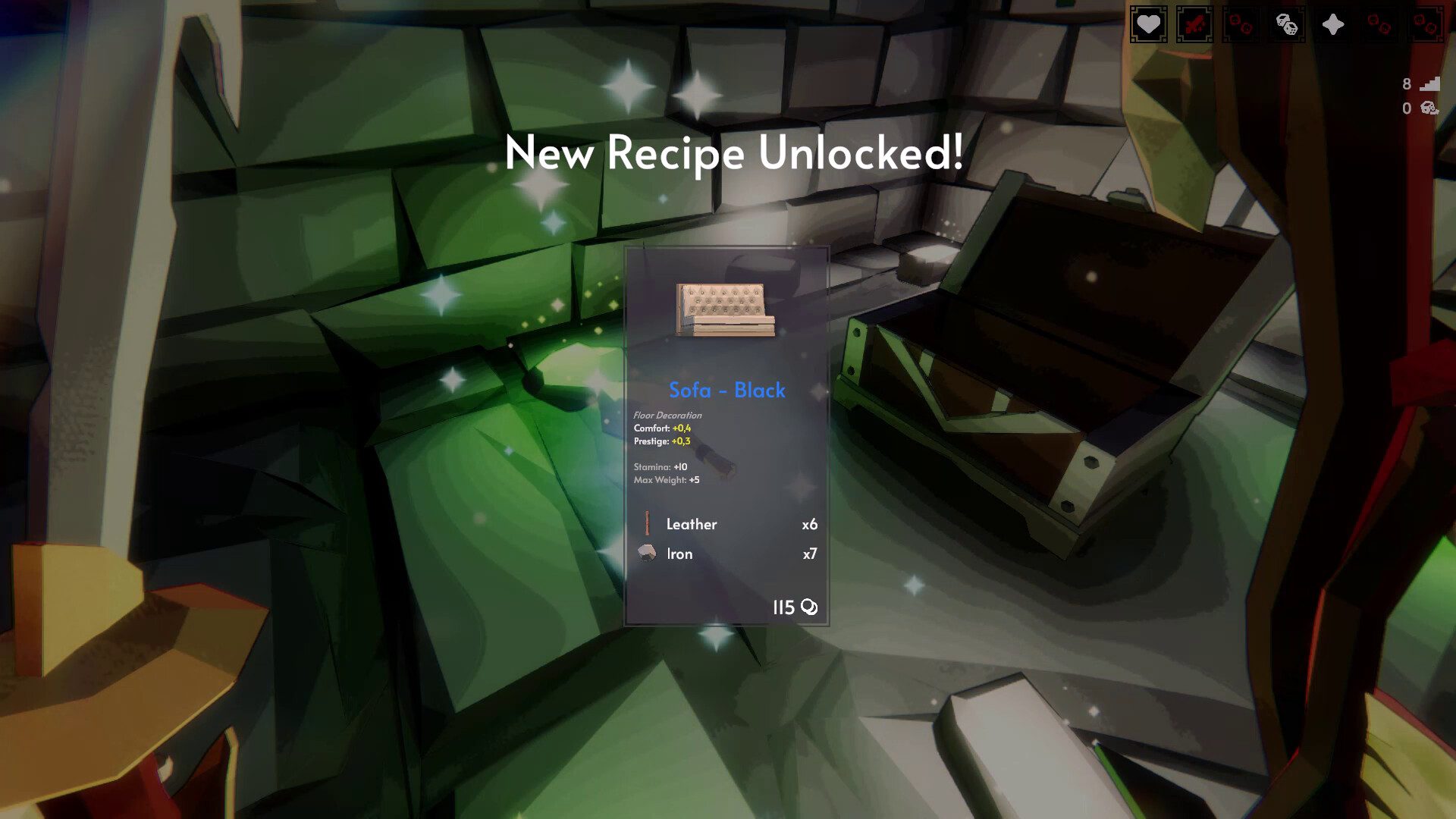
The list is 13 ledgers, not 97 separate errands
| Ledger | Achievement count | Terminal requirement |
|---|---|---|
| All enemy kills | 7 | 1,000 enemies |
| Sword, axe, hammer, and staff kills | 16 | 250 with each weapon type |
| Chest opens | 5 | 75 chests |
| Dungeon floors | 5 | Reach Floor 10 |
| Boss kills | 3 | Kill three bosses |
| Total items crafted | 6 | Craft 60 items |
| Crafted rarity | 4 | Craft Uncommon, Rare, Epic, and Legendary items |
| Total items sold | 10 | Sell 1,000 items |
| Trading gold | 6 | Earn 2,500 gold from trading |
| Category sales | 24 | Magic 50; weapons 80; alcohol 50; bones 50; armor 80; Bloodstone 10 |
| Comfort | 5 | Reach Level 10 |
| Prestige | 5 | Reach Level 10 |
| Death | 1 | Die once |
Those rows total exactly 97. Use them as the audit checksum. If the Steam total is lower, identify the unfinished ledger first; repeating a random dungeon run is slower than knowing whether the missing credit belongs to a weapon, category sale, rarity craft, floor, or shop level.
Build the counter sheet before the first large sale
Create one row for each terminal counter, then add checkpoint columns rather than writing all 97 names. A compact sheet needs:
- total kills: 1 / 10 / 25 / 50 / 100 / 200 / 1,000;
- sword, axe, hammer, staff kills: 15 / 50 / 100 / 250 for each;
- chests: 1 / 5 / 10 / 25 / 75;
- highest floor: 2 / 4 / 6 / 8 / 10, plus bosses 1 / 2 / 3;
- crafts: 1 / 5 / 10 / 20 / 40 / 60 and four rarity boxes;
- sales: 1 / 10 / 25 / 50 / 100 / 200 / 300 / 500 / 750 / 1,000;
- trading gold: 50 / 100 / 250 / 500 / 1,000 / 2,500;
- six sale-category counters, plus Comfort and Prestige levels.
Update the sheet only after the achievement or in-game state reads back. This avoids a particularly expensive mistake: selling or killing according to your memory, then discovering that the item classification, weapon type, or achievement did not register the way you expected.
Make 1,000 kills serve five chains
The four weapon mastery chains each end at 250 kills: Sword, Axe, Hammer, and Staff. Four times 250 equals the MOMO MONSTER KILL target of 1,000 total enemies. That is the clean mathematical route, but only if every kill is credited to the weapon type you are tracking.
- Start with the weapon type that keeps ordinary rooms safest.
- At 15 credited kills, confirm the Novice achievement for that type.
- Continue to 50, then 100, verifying the Adept and Journeyman milestones.
- Finish the type at 250 before casually switching, or record the exact partial count.
- Repeat for the other three types; compare the final weapon achievements with the 1,000-enemy total.
The names are Novice/Adept/Journeyman/Master Swordsman, Axeman, Hammerman, and Mage; the Mage requirements explicitly say Staff kills. Do not infer credit from an item’s fantasy appearance. Let the equipped category and unlock readback decide.
If the 1,000-kill achievement unlocks before all four Master achievements, one category has absorbed more than 250 kills or another category failed to credit. Stop general farming and finish only the missing weapon ledger. If all four Master achievements are complete and the total kill achievement is still locked, preserve the current counts and version before adding more kills; the expected arithmetic has not matched the client.
Let chest and floor gates set the dungeon pace
Dungeon progression has three clean tracks:
- Chests: first chest, then 5, 10, 25, and 75.
- Depth: Floors 2, 4, 6, 8, and 10.
- Bosses: first boss, two bosses, and three bosses.
Open every safe chest on progression runs until 75 is complete; after that, a chest is loot, not achievement work. Do not sacrifice a valuable haul for a chest merely because the counter is unfinished. A separate repeatable chest route can be safer than forcing optional rooms during a new depth attempt.
Version 1.0.2 matters here. It fixed dungeon generation that could block a level, fixed a player freeze after loading a new floor, and keeps player-opened doors open. When a floor appears impossible, verify the version and audit the opened-door route before treating the obstruction as an intended requirement. A bugged route is not a missing achievement condition.
The public list contains two achievements both displayed as Master Dungeoneering: one requires Floor 8 and the other Floor 10. Record the requirement next to the name. Seeing one Master Dungeoneering unlock is not proof that the depth chain is finished.
Craft toward 60 while touching every rarity once
The quantity chain is 1, 5, 10, 20, 40, and 60 crafted items. The separate rarity achievements require one Uncommon, Rare, Epic, and Legendary item. A low-waste plan is:
- Craft what the next dungeon or shop improvement actually needs.
- When a new rarity becomes available, craft one useful item of that rarity and confirm the unlock.
- Reserve scarce materials for the first Epic and Legendary crafts instead of spending them only to inflate the total.
- After all four rarity boxes are checked, finish the 60 total with recipes whose output will be equipped, placed, or sold.
This prevents 60 crafts from becoming 60 pieces of dead inventory. Furniture can affect both combat and sales appeal, while equipment can make deeper chest and boss progress safer. Crafting an item that advances another ledger is better than producing disposable filler.
Sell categories before chasing 1,000 generic transactions
The category chains contain 24 achievements and should drive the stock mix. Their exact terminal requirements are:
| Category | Milestones | Last unlock |
|---|---|---|
| Magic items | 1, 5, 25, 50 | Magic magic magic (magic) |
| Weapons | 1, 10, 20, 40, 60, 80 | …people do |
| Alcohol | 10, 25, 50 | Drunk |
| Bone items | 10, 25, 50 | Undead |
| Armor | 1, 10, 20, 40, 60, 80 | Armor Kingpin |
| Bloodstone items | 5, 10 | Bloody Future |
Keep six labeled stock queues. Sell from an unfinished queue whenever demand and reserves make it sensible, then mark the category only when its achievement appears. The descriptions use singular and plural wording inconsistently, so do not use grammar to infer a hidden rule.
The generic transaction chain ends at 1,000 items and the gold chain ends at 2,500 gold. Category stock is still real merchandise, but the public requirements do not explain every stacking rule. After a category sale, check whether the generic sale and gold milestones progress as expected. If they do, keep combining the ledgers. If they do not, record the current version and separate the remaining work rather than assuming future sales will repair the gap.
Protect progression items while clearing sale counters
A category label does not automatically make an item disposable. Before listing an item:
- keep the best weapon and armor actually used by the current build;
- reserve ingredients for the next rarity craft or furniture target;
- retain one uncertain or hard-to-replace item until its crafting and progression uses are known;
- sell duplicates and true surplus into the unfinished category queue.
Version 1.0.2 fixed two inventory hazards relevant to cleanup. A weapon displaced by an overloaded swap should now drop on the ground rather than be destroyed, and equipping from a stack should move one weapon, shield, or armor item rather than the whole stack. Inspect the ground, equipment slot, and remaining stack after any risky rearrangement; do not let achievement cleanup turn into an avoidable inventory loss.
Raise Comfort and Prestige as long projects
Both shop-stat chains use Levels 1, 3, 5, 7, and 10. The official store description gives them different jobs: Prestige affects acceptable selling prices, while decoration bonuses and shop appeal participate in the sales system; official screenshots and achievements separately expose Comfort progression.
Track the two levels independently. Before selling or dismantling furniture, compare its immediate gold with the next Comfort or Prestige checkpoint and any combat benefit it provides. A piece that moves one of those ledgers or improves dungeon survival may be worth more placed than sold.
Do not publish a universal furniture layout or fixed cheapest path from this evidence. Recipes, availability, demand, and balance can change. The reliable procedure is to place one planned improvement, read the resulting level, and keep it only if it moves the intended stat without breaking a more valuable setup.
Handle the one death and three bosses deliberately
The first pancake is always spoiled requires one death. If it has not unlocked naturally, schedule it only after depositing valuable loot and removing anything you are not prepared to lose. The achievement asks for a death, not an expensive failure.
The boss chain requires one, two, and three kills. The supplied Boss pages cannot support a current tactical route: they describe a turn-based party with healers, tiles, AP, Holy damage, and named roles, while Fell & Sell is officially a first-person action game. The attached video is also a July demo walkthrough, predating Demo 2.0 and the full release. This roadmap therefore tracks boss credit but does not invent names, health values, phases, or builds.
For each boss, preserve three readbacks: the boss defeat state, the achievement unlock, and the inventory or route state after leaving the arena. If a kill animation occurs without achievement credit, do not assume the next boss will fix it. Recheck the current client, completion state, and whether the encounter fully ended.
Resolve duplicate names by their requirements
The public list contains two confusing pairs:
- Getting better! can mean “Craft 5 Items” or “Sell 25 Item.”
- Master Dungeoneering can mean “Reach Dungeon Floor 8” or “Reach Dungeon Floor 10.”
Never cross one of these off by title alone. Store the requirement beside the title in the counter sheet. The apparent duplicate is not a reason to repeat the same action; it is a reason to inspect the description.
Run the 97-item checksum before grinding again
At cleanup, count completed achievements by the 13 ledgers in the first table. The completed counts should add to 97. If they do not:
- compare all four 250-kill weapon caps with the 1,000 total-kill cap;
- check chest 75, Floor 10, and boss three separately;
- verify both quantity crafting and all four crafted rarities;
- compare six category-sale caps with the 1,000 generic sales and 2,500 gold;
- verify both Level 10 shop stats;
- inspect the two duplicate-name pairs by requirement;
- confirm the single death achievement.
For the opening loop that supplies these counters without wasting the first haul, use the beginner shop-to-dungeon route. Its goal is a repeatable conversion cycle; this article’s goal is the separate long-term audit.
Official sources and evidence limits
The public Steam achievement page supplies all 97 names and requirements, including the duplicate display names. The official Steam listing confirms the full-release identity, shop and dungeon systems, crafting, dynamic pricing, Prestige, and decoration effects. Official announcements establish the August 26 release and Version 1.0.2 inventory and dungeon fixes. The roadmap groups only explicit counters; it does not claim hidden stacking rules, permanent prices, current boss tactics, guaranteed drops, or a fixed furniture build.