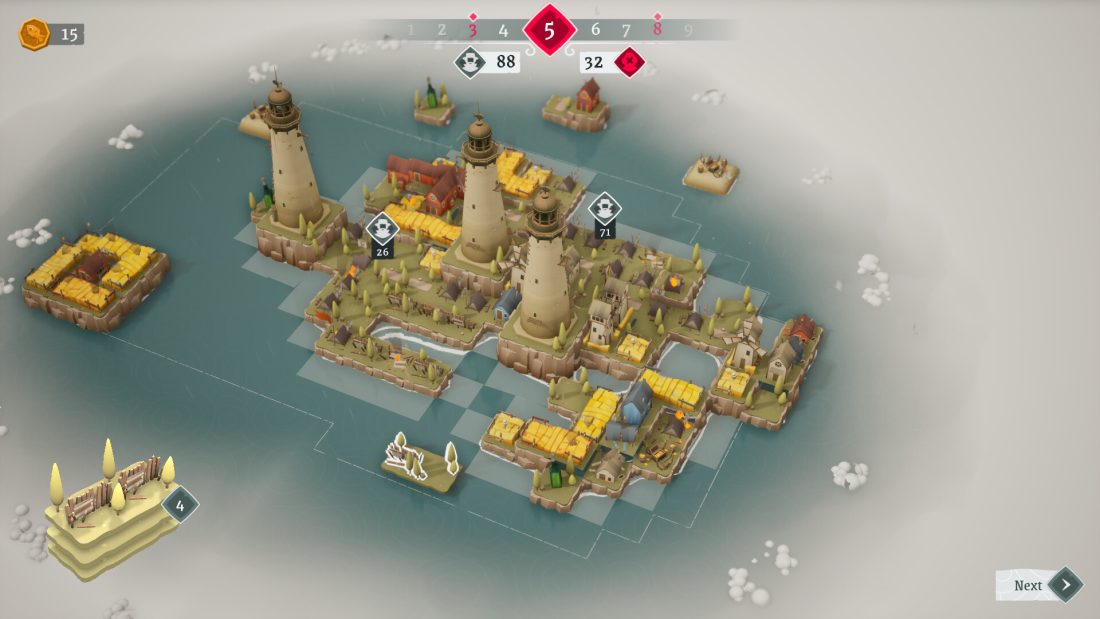
The dangerous ShoreTiles placement is not always the tile with the smallest coin reward. It is the tile that pays now and creates a coast your army cannot cover when The Drowned arrive. A strong first island therefore needs one continuous decision loop: make a documented match, keep the new edge defensible, spend the reward on the job the island is missing, and stop expanding early enough to organize the night defense.
This strategy is for the full Windows release available on Steam from September 3, 2026, with the Day One Update taken into account. ShoreTiles uses randomized draws, so it would be misleading to prescribe a fixed opening grid. The useful route is a set of checkpoints that survives a different tile order.
The real cost of a tile is paid at night
Every placement is permanent, while the offered sequence changes from run to run. That combination makes the empty water around a new tile part of its cost. A farm that finishes a match may be economically useful, but placing it at the end of a thin arm also creates a longer approach to the lighthouse. A military tile on a disconnected patch may add capacity yet still leave the resulting force on the wrong side of the island.
Before placing anything, read the offer through three lenses:
- Match: can the tile touch the same useful type, and does its color reinforce the reward shown by the interface?
- Shape: does the placement close a compact area or create another protruding coast, channel, or isolated section?
- Response: which army, wall line, boat link, or light will protect the new approach when the phase changes?
If the third answer is only “I will solve that later,” treat the placement as an expansion purchase, not a free combo. The official launch explanation explicitly ties larger islands to more ground that must be protected. That warning is the bridge between the puzzle and defense halves of the game.
First daylight: close one economy loop
Farms beside farms and mills beside mills are the named launch examples for earning bonus coins. Matching colors can increase the reward further. Those are reliable priorities; a universal payout chart is not. Use the number displayed by the current client, because the public material does not publish a fixed multiplier, a complete color table, or a permanent price schedule.
Your first economic target is not “collect every color.” It is to build one cluster that can keep producing choices without pulling the shoreline in several directions. Prefer a placement that touches an existing farm or mill and keeps at least one clean edge available for the next related tile. If a color match requires a long spur, compare the visible extra reward with the defense you would need to assign to that spur. A smaller, repeatable cluster is usually easier to convert into military security than two promising half-clusters on opposite sides of the lighthouse.
Use the following tiebreakers when two placements both score:
- Choose the one that completes a current match over the one that merely hopes for a later draw.
- Choose a shared edge near the existing island over a single-tile neck unless the distant tile unlocks an immediate defensive or progression benefit.
- Keep a space where the next farm, mill, camp, wall, or connecting tile can do more than one job.
- Do not spend the last flexible coins to perfect a pattern if the current coast still lacks a believable response route.
This is not an instruction to make a symmetrical island. Random draws may force an irregular shape. The goal is legibility: when you look at the coast, you should be able to name which group can reach each exposed route without abandoning the lighthouse.
Merchant stop: buy the missing job
The merchant turns earned coins into more tile choices. The current Steam gallery shows Civilian, Militia, and Lighthouse groups rather than one undifferentiated pile. That is the useful way to read a purchase: buy a function that completes the next loop.
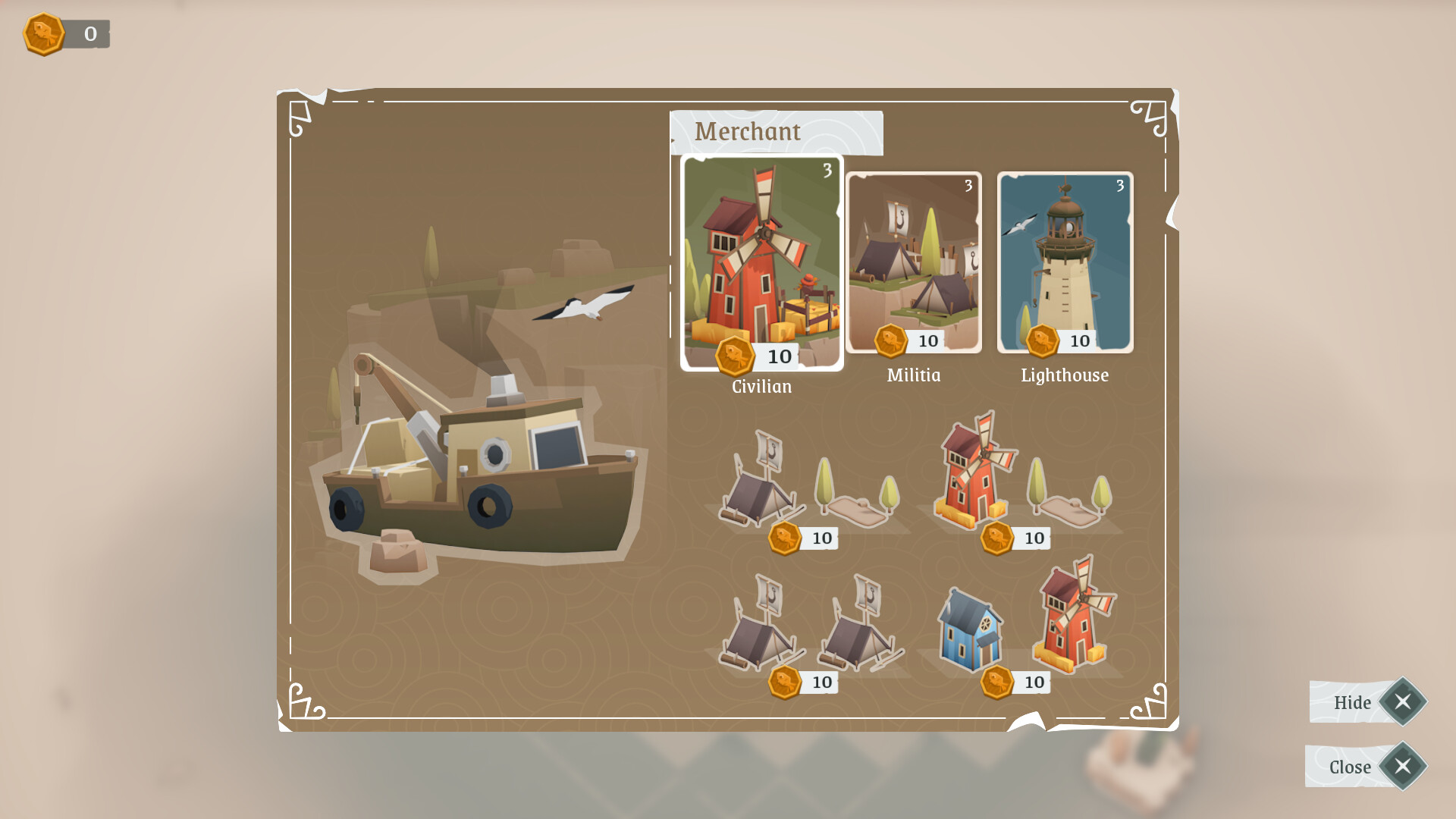
Ask what fails if night starts now:
- If income has stalled, complete a documented farm or mill relationship before opening another speculative cluster.
- If one coast has no force that can reach it, the missing job is military coverage or a connection, not another profitable-looking arm.
- If useful space is hidden, a lighthouse or brazier can push back fog, but only after you can protect the land that action exposes.
- If a separated area already has value, a boat can be more relevant than stretching a vulnerable land bridge toward it.
Coins are control because they preserve alternatives. An empty purse and an unfinished pattern leave the next random offer in charge of the run. Keep enough flexibility to answer the weakest current dependency rather than clearing a merchant panel because all three categories look useful.
Fog break: expand with a return route
New lighthouses and braziers are both described as ways to push back fog. They should not be treated as identical objects: the official material does not establish that their range, cost, durability, or stacking behavior is the same. Read the area shown by the current placement preview and make the choice from that visible boundary.
Opening fog is worthwhile when the revealed space does at least one immediate job: it completes an income connection, gives a military group a cleaner route, reaches a useful discovery, or advances a progression objective you are ready to support. It is premature when it merely creates more possible edges while the present island is still under-defended.
The fog can contain chests, relics, blessings, curses, new buildings, and new dangers. That makes expansion valuable but not automatically safe. Use a four-question gate before committing:
- Can the present economy pay for the light and the follow-up tile or repair it enables?
- Does the new area connect to a force, or will it become a separate front?
- Can The Drowned approach the central light through the opened section, and where would a wall redirect that route?
- If the reveal is disappointing, can the existing island still survive the next night without another purchase?
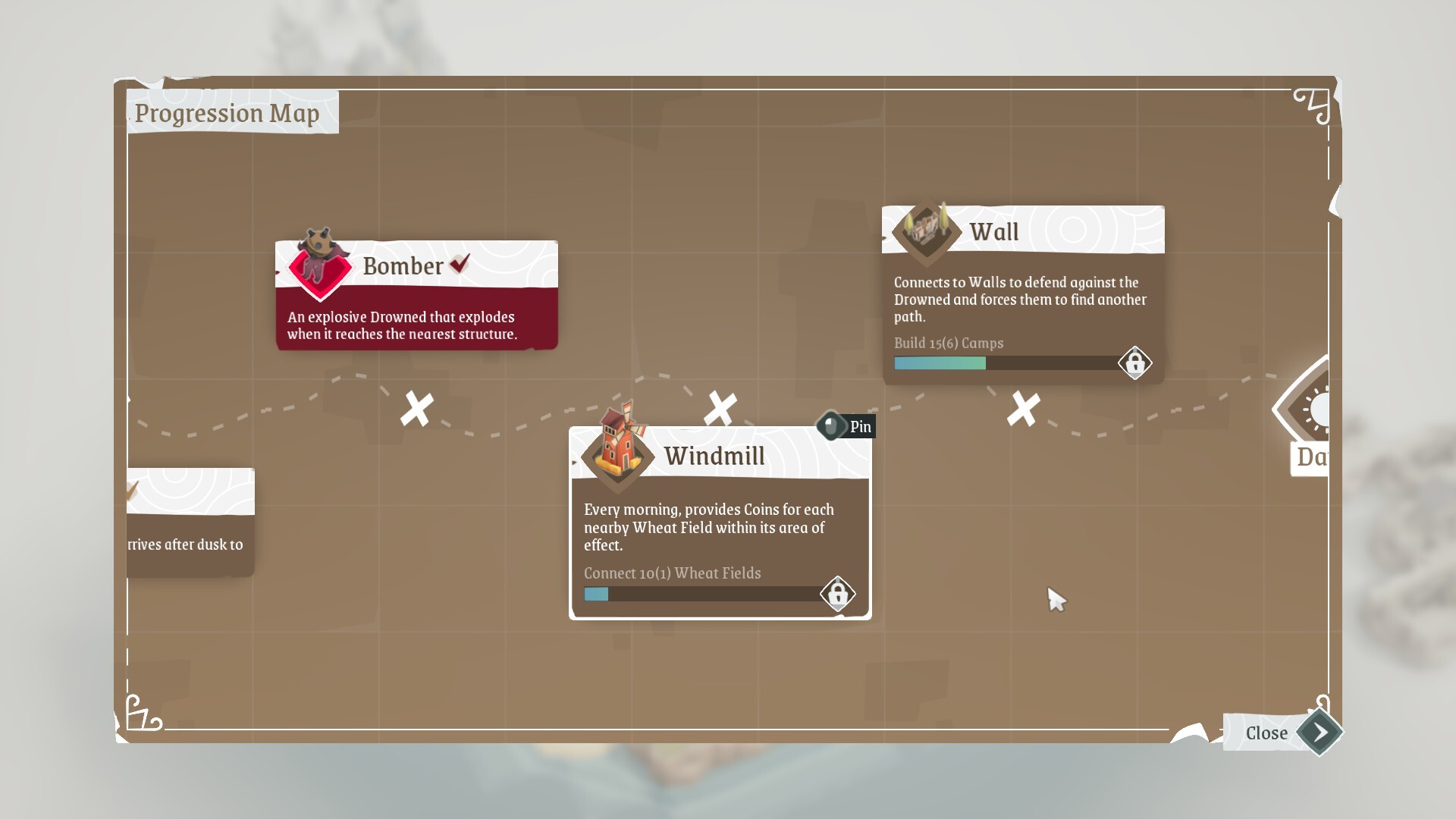
Treat the Progression Map as a capability plan, not a shopping list. If a desired unlock asks you to repeat an action, complete it when that action also improves the current island. Forcing a weak camp placement or a poor wheat connection only to move a bar can make the immediate night harder than the future unlock makes it easier.
Nightfall: let geography choose the army pattern
Connected military tiles determine how many units are available, and the launch material gives two valid ways to use camps: combine them into a stronger army or keep forces separated to cover several fronts. There is no single “always merge” answer. The island shape decides.
Concentrate when most exposed routes converge near the lighthouse, a wall can funnel attackers toward one area, or the enemy threat on one side clearly exceeds the others. The advantage is force density. The risk is travel time: a powerful group cannot protect a distant section if it arrives after the important structure is already under pressure.
Split when the island has distinct coastlines, separated lights, or valuable regions joined poorly by land. The advantage is presence on both fronts. The risk is creating two groups that are each too weak to finish their fight. The official launch post assigns boats the job of reinforcing land sections cut off from one another, so include boat access in the plan before assuming two areas can support one another.
Walls are route tools, not a substitute for units. The Progression Map image in the current Steam gallery describes connected walls as obstacles that make The Drowned seek another path. Use that behavior to simplify the defense map: redirect one awkward approach toward a force that already has a short route, rather than scattering walls around every structure and leaving several unclear gaps.
Use the last daylight check to name every threat route
Do not wait for the first enemy marker to discover that a military group is isolated. Before ending daylight, rotate the camera and perform one full circuit from the outside inward.
- Mark every exposed coast. An outer edge is a possible workload even if the next wave does not use it.
- Trace each inward route. Follow the path toward the vulnerable lighthouse and note where walls change it.
- Assign a group. Each important route needs one named responding force, not a vague assumption that the nearest units will handle it.
- Check the crossing. If the route passes between separated land sections, verify the boat or land connection now.
- Find the slow rescue. The route that takes longest to reinforce is the one to shorten, wall off, or station separately.
A compact island can often support one combined group because travel paths overlap. A branched island pays a coordination tax: either split the army, build a reliable reinforcement link, or accept that one branch is expendable. Naming that choice before night is more useful than reacting to several flashing problems at once.
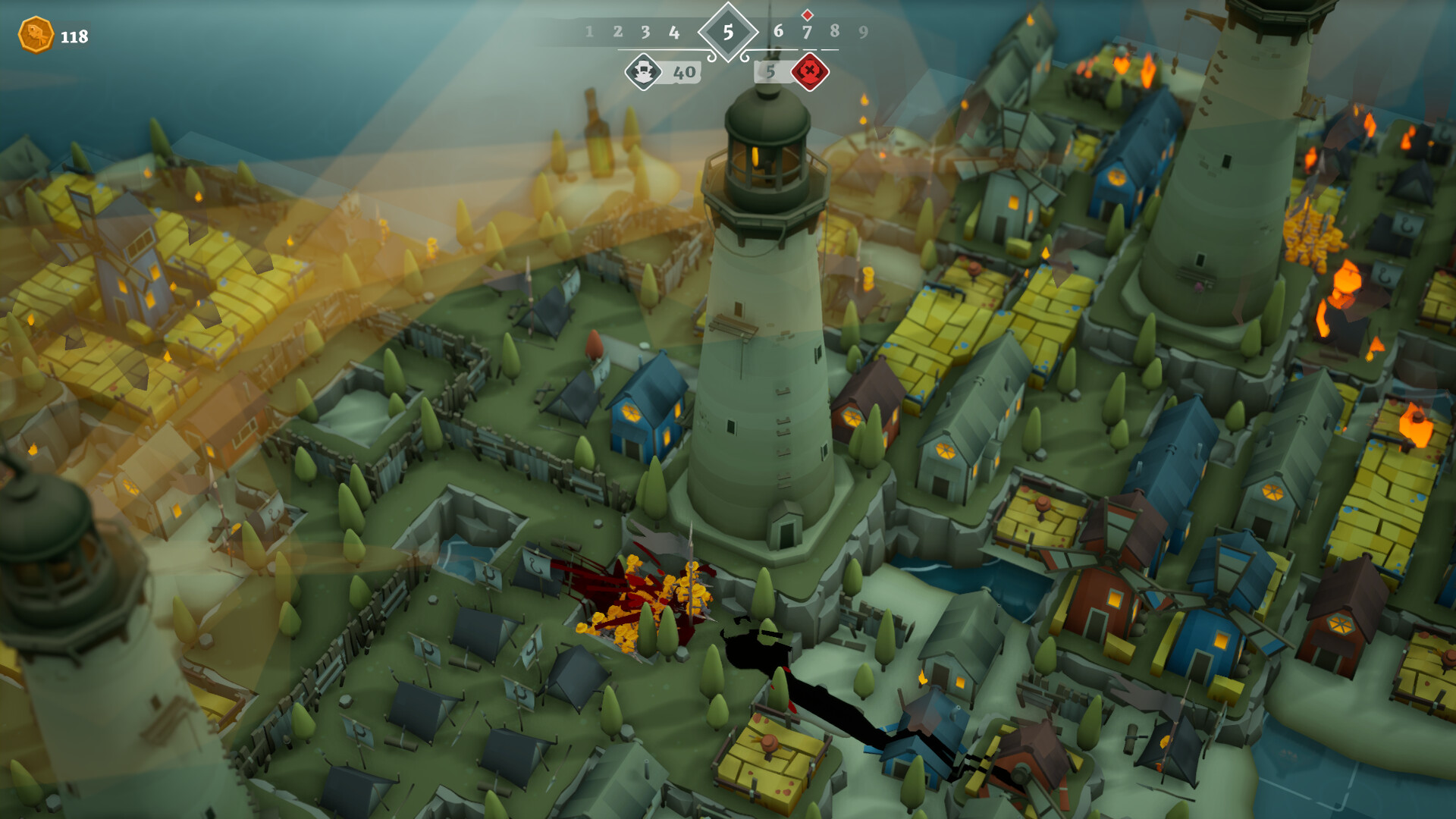
Combat: correct position before chasing damage
The September 4 Day One Update changed the control context. Voxel Studios added box selection, improved unit selection, position indicators, troop movement, and combat readability. It also fixed soft locks involving a Gunner outside the fog or unable to be attacked. Advice recorded from the pre-release demo should therefore not be treated as the current control map.
Use those controls as a correction layer for the plan you made during daylight:
- Select the group responsible for the threatened route before dragging unrelated units away from a second front.
- Read the position indicator before issuing another move; repeated orders can hide the fact that the route itself is poor.
- Protect the lighthouse approach first. Chasing a target toward the outside is a losing exchange if another path has opened behind the force.
- When the situation resembles the patched Gunner soft lock, stop treating it as a tactical failure. Confirm the game is updated, preserve the state you can report, and restart only after recording what happened.
No public source used here provides a complete unit-stat table, enemy targeting formula, wave calendar, or guaranteed troop threshold. Watch what the current UI reports and move according to the visible route; do not build the island around a number copied from an older demo run.
The supplied long run is useful as a map-reading example
The recording below is RonEmpire’s June 21 Steam Next Fest playthrough. The attached local file matches the public video’s 2:32:37 duration and shows Demo 1.0.58 on its settings screen. It demonstrates how one island can grow from a central lighthouse into several connected and separated sections, but it predates the full release and Day One control update. Use it to study spatial commitments, not current prices, ranges, unlock requirements, or combat balance.
Morning: repair the decision that failed first
After a night, do not resume expansion simply because the lighthouse survived. Find the earliest broken dependency. Damage at the end of a long arm may be a shape problem; a force arriving late may be a connection problem; two groups losing separately may mean the island needed concentration; one route going unanswered may mean the split happened too late.
| Failure signal | Likely decision to revisit | Next daylight action |
|---|---|---|
| Coins are gone and no useful match is close | Several partial clusters consumed flexibility | Finish one farm or mill relationship before opening another |
| A strong army arrives after structures take damage | Force density is fine, but travel distance is not | Shorten the route, redirect it with walls, or station a second group |
| Two fronts collapse independently | The army was split below a workable strength | Concentrate camps and reduce the number of active approaches |
| New fog space adds danger without income or progress | Expansion happened before the island could absorb it | Stabilize the old coast and save coins before the next reveal |
| A unit cannot be selected, moved, or attacked normally | Possible build or state problem rather than a strategy error | Confirm the Day One Update, record the sequence, and report a reproducible issue |
The next tile should repair that first failure or fund its repair. This keeps progression attached to survival. Chests, relics, blessings, curses, and unlocks are valuable, but reaching them is not progress if the route to the central light has become unreadable.
Release boundary: verify values in the current client
ShoreTiles launched on Steam on September 3, 2026. The official Day One Update followed on September 4 and specifically changed combat control and readability. This guide therefore avoids fixed prices, color multipliers, light or brazier radii, wall durability, unit ranges, enemy counts, wave timing, progression requirements, and claims about an optimal opening. Those values are either not published in the current official text, visible only in undated gallery captures, or demonstrated in the older Demo 1.0.58 recording.
When the client disagrees with a screenshot or community page, trust the live tooltip, placement preview, Progression Map, and current official patch notes. The strategic test remains stable even when a number changes: a placement must improve income, shape, or defense enough to justify the new coast it creates.
Official game link
Sources and credits: Steam’s AppID 4268460 record supplies the game identity, release state, gameplay description, and four untouched gallery JPGs. The economy, camp, boat, fog, and launch-scope details were checked against the official release announcement; the control boundary comes from the official Day One Update. Community guides were used only as cautious cross-checks where they preserved the same evidence limits.